CLUB HISTORY
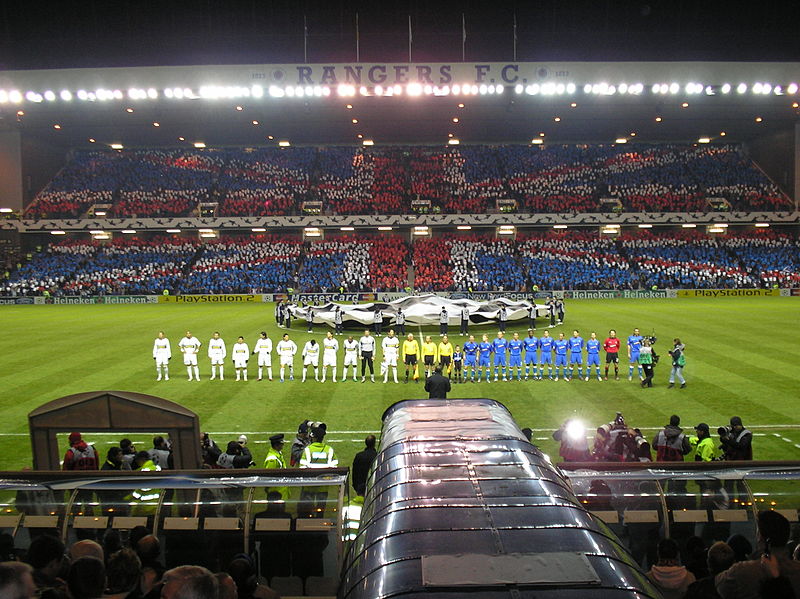
When Rangers first opened for business in the late nineteenth century, the dominant team in Scottish football was Queen's Park, a team of devoted amateur gentlemen, and it was symbolic of Rangers position that their opponents sent their reserve team, quaintly named the Strollers, to play them. Now Queen's Park languish in the Third Division while Rangers have 51 Championships to their name. The change in status reflects not only the inevitable rise of professionalism but the determination of Rangers motto 'Ready' - to be the best. Their Ibrox Stadium is the envy of clubs the world over, with a current capacity of some 51,082 in all-seater comfort, and the spending spree of summer 1997, which saw then manager Walter Smith breaking the bank to bring the cream of Europe's talent to the blue half of Glasgow, underlined the fact that chairman David Murray intended to maintain their pre-eminent position in Scottish football and extend it to the continent. The name of Rangers first came to public attention in 1873 when the club was founded by a group of rowing enthusiasts, Peter Campbell, William McBeath and brothers, Peter and Moses McNeil. They had their first match on Flesher's Haugh at Glasgow Green. It was against Callander Football Club and the final score was 0-0. They played their first games on numerous different pitches, including an area of parkland known as Flesher's Haugh and then Kinning Park before moving to Burnbank, and then opening their first Ibrox Park in 1887 (the current Ibrox was built on a nearby patch of land some 12 years later.) The name Rangers was adopted from an English rugby club. By their second fixture - the only other they played that first year - they had donned the light blue. It must have done the trick - Rangers beat Clyde 11-0. The Old Firm Though Queen's Park were the power in the land, a more intense rivalry that sprung up was with another Glasgow neighbour, Celtic. Indeed, the pair had locked horns in Celtic's very first match in May 1888. Against the odds, it was the side in green that ran out 5-2 winners - Rangers having reportedly contributed to their own downfall by 'doing a Queen's Park' and fielding a reserve team. The crowd was some 2,000 strong, women being admitted free and others paying sixpence a head. Yet the most fascinating fact must surly be that the two sets of players chose to wind down together by sharing tea in a local hall. Hardly the image of the fixture in more recent years..... The Scottish League opened for business in 1890 - 91, and Rangers were quickly out of the blocks. Sharing the very first title with Dumbarton. September 1898's meeting with Celtic had attracted a crowd of 44,868 - underlining the fact that the 'Old Firm' rivalry, as it became known, was already highly profitable in terms of bodies through the turnstiles. It was clear too, that the old order, in the shape of Queen's Park, was about to change in the face of the dual domination from the blue and the green. The first Old Firm clash in the Scottish Cup had taken place in 1890, and they met again in the Final four years later when Rangers ran out winners by three goals to one. The sides would meet once more in the Final in 1889, with Celtic this time taking delight in depriving their rivals of a first League and Cup Double. Nevertheless, Rangers were in the ascendant at the turn of the century, with four League title in a row. The season of 1898 - 99 was particularly memorable, in that it saw Gers win all 18 games to establish a perfect record. But Celtic then took over, and though Rangers had the chance to foil a third League and Cup Double in 1909, the Scottish FA withheld the Cup due to disgraceful scenes after a pitch invasion by a drink - fuelled hordes. The 'Hampden Riot' had written itself a sorry page in the history books, and both clubs were ordered to compensate hosts Queen's Park for the damage caused by their so - called fans. Cup Hat - Trick Rangers' managerial regime was very stable: Bill Struth, a former player, became the club's first secretary - manager after secretary William Wilton drowned in 1920. By the time of his retirement in 1954, Struth had gathered 18 League titles, reached 10 Cup Finals and two League Cup Finals. The key statistic of the 1930s was three consecutive Scottish Cup wins from 1934 - 36. History was there to be made in 1937 when they set out on the trail of a fourth win, only to loose in the First Round to lowly Queen of the South. Ironically, this was the first Rangers game ever to be immortalised on film. The post-war seasons saw Rangers well on top, but not before a boardroom coup in the summer of 1947. The board of Rangers had previously been an amateur body made up of former player, but when chairman Jimmy Bowie suggested Bill Struth stand down, a revolution occurred. In many ways, this was the first stage of a process that would lead to the club's purchase by David Murray in 1988. The 1948 - 49 season brought an historic 'treble' of League, Cup and League Cup never before achieved, the success based on the so - called 'Iron Curtain' defence which remained virtually unchanged from 1946 to 1953. Another purple patch began at the end of the 1950s: from 1957 until 1965, Rangers achieved four League titles, plus an equal number of wins in both League and FA Cups. This was the era of 'Slim Jim' Baxter, a superb ballplayer who was by turns exhilarating and exasperating. But though Baxter was to depart for England in 1965, there was a player who had been a fist - team regular for the past couple of seasons who would mature into an inspirational leader, a stalwart in the dark blue of Scotland and would eventually manage the club. John Greig was that man, and though Rangers would play out the decade in the shadow of their European Cup - winning neighbours, the foundations were being laid for future success. This would not be achieved under long - serving boss Scot Symon, who had replaced Bill Struth in 1954. He paid the penalty of Celtic's success in Scotland and Europe in October 1967, giving way to his former assistant Davie White who would in turn be replaced two years later. Willie Waddell, who brought the Championship to lowly Kilmarnock in 1965, made an immediate mark when the League Cup was secured by a single Derek Johnstone goal in 1970. The new man was to step upstairs in 1972, handing over responsibility for playing matters to Jock Wallace, but would prove a rock in the months to come. Crowd Catastrophe The old adage, attributed to Bill Shankly, that 'football's not a matter of life and death...it's more important than that' was shown to be false by the tragic events at Ibrox on 2 January 1971. The traditional New Years Day fixture had been postponed for 24 hours to the Sunday to give an extra day's break from Hogmanay hangovers, and the 80,000 crowd was well behaved. With Celtic marginally in the lead, many Rangers fans decided to head home before the final whistle. Yet cheers from the crowd in the stadium on Colin Stein's last - gasp equaliser had the effect of reversing the flow of the exodus, with disastrous results. Sixty-six lives were lost that day, uniting the city of Glasgow in grief. Willie Waddell was horrified by the tragedy: he orchestrated the club's response, ensuring players were at every funeral, and it was largely thanks to his perseverance and vision that Ibrox was redeveloped in a manner that made it, however belatedly, a state of the art stadium with spectator comfort and safety at its core. Jock Wallace's drive boosted blue fortunes on the pitch, especially when the Gers grabbed their own long - awaited share of European glory in Barcelona's Nou Camp stadium in 1972. The triumph was tainted by crowd trouble, exacerbated by the fact that, 3-0 up against Dynamo Moscow, Rangers lost concentration and ended up hanging on grimly to a 3-2 lead at the final whistle. A pitch invasion, however well - intentioned, by relived Rangers fans was repelled by a baton charge and the resulting scenes of violence, broadcast live across Europe, ended with a European ban, originally for two years but bartered down to one. This however, denied the players who'd fought so hard to make their European mark the chance to defend their title. Their defeat of Bayern Munich in particular had been remarkable, winning through despite the absence of the injured Greig. On the domestic front, a League Cup win over Celtic in 1971, when Wallace was coach, followed by victory in the Centenary Cup Final in 1973, had suggested better times to come - and three titles in 1975, 1976 and 1978, the last two Doubles, proved that the pendulum was indeed swinging as Jock Stein left the Glasgow scene. Jock Wallace gave way to John Greig, who found himself taking charge just as a century of history was about to be turned on its head. The Glasgow giants had been caught by the passage of time, and what some commentators coined 'a New Firm' of Aberdeen and Dundee United had emerged to challenged the big city's dominance. Greig's first five years at the helm brought two cups but no League title, and he resigned after just a few games of the 1985 - 86 season, his last major act having been to sign Ally McCoist from Sunderland. Former Ibrox favourite Alex Ferguson, the man who'd driven Aberdeen to glory, turned down a return in a managerial capacity, so Jock Wallace was granted a second spell. As so often happens, it was not to prove as profitable as the first, and Rangers ended 1985 - 86 with fewer points than games: fifth place was their equal worst post-war showing. A January 1986 take-over off the club by the john Lawrence construction company brought fresh faces into the boardroom, and it was inevitable that change would eventually permeate down the club's structure by the first player - manager in Rangers' history . Graeme Souness, fresh from a trophy - studded career with Liverpool and latterly in Italy, broke the 'Old Firm' mould in more ways than one. Most importantly of all, he'd dismantle Rangers' 'no Catholics' policy at a single stoke in July with the recruitment of Maurice Johnston, the high - profile Celtic striker who'd recently played in France. Anglo Invasion Souness' arrival at Ibrox in April 1986 heralded an amazing turnaround in the club's fortunes - but he was forced to admit defeat on one front. His intention to pursue a playing role was too high - pressure to sustain, especially for a whole - hearted and combative midfielder. This became apparent in August 1987 when he spoke out of turn to the referee and was sent off, having committed a second bookable offence. He continued his argument after the game, winning himself a fine from the SFA and confirming what many had thought. His forays on the pitch had tapered down to six subs' appearances by 1988 - 89, compared with 25 and 18 games in previous seasons. Souness stuck gold in what was his first season in management, aided by a stream of high - quality (and often high - priced) players from south of the border. Terry Butcher and Chris Woods, both regulars in the England rearguard, patrolled the penalty area with fellow international Graham Roberts, while the like of McCoist and Fleck popped in the goals up front. A Championship and League Cup Double was an impressive start, but despite the arrival of the likes of Richard Gough, Trevor Francis and Ray Wilkins, only the League Cup could be retained the following term. The teams Souness selected took no prisoners, but the 'Old Firm' clash of 17th October 1987 was memorable for events that ended not with the final whistle but in a court of law. Woods, McAvennie and Butcher had all been dismissed for violent conduct during the game, while Roberts was also implicated. Woods and Butcher were found guilty in what was the first example of the Scottish legal system involving itself in matters on the pitch. If Rangers, matches were more eventful these days than before, results certainly reflected a growing feeling that the Gers were on the march. The Championship returned in 1988 - 89, the League Cup staying in the Ibrox trophy room for a club record third season. Maurice Johnston's arrival, as previously mentioned, grabbed most of the headlines in the summer 1989, but Trevor Steven's arrival to play on the right of midfield was crucial in ensuring the club's second title. Souness Departed After Championship number four of his reign, but battle with Aberdeen had gone to the wire: a League Cup Final win against Celtic was the icing on the cake. If the manager's decision to return to his spiritual home, Anfield, had been an unpleasant shock, at least the Ibrox directors didn't have far to look for a replacement: Walter Smith, though he had no previous managerial form, was well capable of taking the reins and buildings on what had already been achieved. If Graeme Souness' Ibrox reign had set everything on it's head, his shock departure in 1991 to return to Anfield threw Ibrox in to turmoil. (Ironically, it was ex Celt Kenny Dalglish's equally unexpected exit that had opened the vacancy.) Sensibly, the board nominated his assistant Walter Smith as his successor, and the wisdom of that decision is shown by the fact they kicked off the 1997-98 season looking for their tenth consecutive title. As supporters of both sides barely needed telling, this would eclipse Celtic's record set in the jock Stein era. While the Celtic board went through ,managers as if discarding playing cards - Glasgow was hardly the place to learn the managerial ropes - Smith, backed by chairman David Murray's millions, quietly continued attracting the cream of Europe's footballing talent to Ibrox. A rapid outflow of Souness' Englishmen in Woods, Steven and Walters was replaced by another trio from south of the border in Goram, McCall, and Gordon, while Rideout replaced Everton bound Mo Johnstone - a gamble that had not really come off. One player already on the staff to shine in Souness' absence was Ally McCoist. Relegated to the bench so often in recent years he must have had splinters, Super Ally was a man reborn and proved it with a career best 41 - goal haul that almost single - handily guaranteed Rangers their fourth title in a row. The fifth would be part of a golden Treble, in 1992-93, that underlined the fact that Walter Smith had not only carried on the Souness era but built on it. Making His Mark The player who survived the 'purge' of Englishmen to prove a match - winner in the Smith era was Mark Hateley Son of former Liverpool striker Tony, he overcame fan antipathy to prove a mighty effective spearhead. Indeed it was his second goal against Aberdeen, their nearest challengers in the League, that made the Cup safe. It was to be Dons who ran Rangers closest in 1993-94, but Hateley once again proved talismanic, his 42 appearance yielding 22 vital goals. The Englishman's contribution was made even more vital by the fact that Ally McCoist was just one member of a spiraling injury list. Having broken a leg while on Scotland duty, he came back to score a dream decider in what was, incredibly, Rangers seventh League Cup Final in eight years, leaving opponents Hibs distraught as the chance of extra time was snatched from their grasp. Equally last - gasp was Rangers' hunt for the Treble. Opponents Dundee United had not enjoyed the best of seasons, but a single goal sent the underdogs back to Tannadice Park rejoicing. Some blamed reserve keeper Ally Maxwell for the upset, but in truth he was sold short by a Dave McPherson backpass, and it may have been no coincidence that Bid Mac was on his way back to Hearts shortly after the season's end. Europe had seen them lose out to Levski Sofia in the First Round through something of a freak goal. Smith strengthened his team in customary fashion during the summer of 1994, but the close season saw him pull off a transfer that had the world sitting up and taking notice. Great Dane Brian Laudruap was the man who would consistently turn on the flair to keep the Ibrox faithful in ecstasies, and his match - winning performances were rewarded with both the Scottish PFA and the Football Writers' Player of the Year Awards in 1995. Such was Rangers' dominance of the domestic scene that Smith was able to afford the odd high - profile mistake, such as French stopper Basile Boli, who proved a less than impressive replacement for McPherson. European Anguish The 1994-95 season was something of a cakewalk for the Blues, only Motherwell putting up any Championship resistance but being a whopping 15 points in the Ibrox team's wake. It was becoming a recurring pattern that while Rangers were far too good for Scottish opposition they were unable to stamp that same authority on the European game. The departure from the Champions Cup against AEK Athens happened in August, of all times , and cast something of a shadow over the forthcoming season. Analysis of the team sheets revealed no fewer than 33 names, but the backbone of the season was a 15 game unbeaten run that started with a 3-1 win over Celtic at their temporary home, Hampden Park. Domestic Domination Rangers completed their third Double of the 1990s in 1995-96 and, with three wins and three draws, showed they were very much the masters in 'Old Firm' terms despite the return of ex- Celt Tommy Burns to Parkhead as manager. England playmaker Paul 'Gazza' Gascoigne was the man who made everything tick. Gordon Petric and Stephen Wright were also recruited to stiffen the centre and right of the defence and options to a squad that Walter Smith utilised in a continental 3-5-2 formation, wing - backs pressing into midfield in an attempt to play the foreigners at their own game. In the absence of Pieter Huistra, bound for the Japanese J- League, Smith had added attacking flair of the Continental kind in Oleg Salenko. The Russian international who'd hit a record five for his country in a World Cup match with Cameroon, was a consolation prize after the intended capture, Romania's Florin Raduciouiu, escape the Ibrox net. In January 1996, Rangers replaced him with Dutchman Peter Van Vossen (in an exchange deal) and Denmark's Erik Bo Anderson, who'd created a big reputation with Aalborg. Those players were vital additions to a squad that again was ravaged by injury, notably the striking pair of McCoist and Gordon Durie. Had Smith appreciated that the duo would be stricken this way, it's certain he'd have retained Mark Haetley, who left to help former team - mate Ray Wilkins in his attempt to prevent Queens Park Rangers' relegation from the top flight. Hateley would return from his fruitless stay south of the border to aid the Gers during the last few months of the 1996-97 campaign. The retention of the Championship pennant was crucial to all at Ibrox, for it would ensure Rangers a share of the nine - in - a -row record held by their city rivals. No sooner was the ninth consecutive title under their belt than Rangers were making plans for the future. A vote of confidence was placed in the current managerial team of Walter Smith and Archie Knox by extending their contracts until the millennium, ensuring continuity leadership. Continental Class Just as important though was the May 1997 appointment of Dane Tommy Moller-Nielsen, son of former national team manager Richard, as first team coach. Chairman David Murray explained his thinking was very much on the European campaign to come, and improving Rangers' disappointing recent record in that respect.' It's one thing saying we are a big club,' he pointed out, 'it's another thing going and doing it.' Moller-Nielsen revealed he'd been following Rangers for 15 years. 'The connection came through Kai Johanneson, a former Rangers player, who was friendly with my dad,' he explained. With Mark Hateley departing for a player - manager post with Hull City and Alan McLaren's knee operation likely to keep him out of the start of the new season - injury having plagued him seven months of 1996-97 - it was clear that Walter Smith would be casting an eye over the transfer market in order to strengthen his squad. Despite the possibility of a tenth consecutive title, the European Cup also loomed large in Smith's plans. Kicking off their campaign against Faroe Island Champions GI Gotu, Rangers would also need to dispose of Swedes Gothenburg before they could enter the group stages. The names on display in 1997-98 - Amoruso (from Fiorentina) and Stensaas (from Rosenburg) were two more summer signing - would not instantly be familiar to the Ibrox faithful. Whether they could conquer Europe while eclipsing their rivals' title ambitions at home remained to be seen. Yet, as ever, anyone wearing that famous shirt and putting their all into it would be hailed as a conquering hero....and a potential All-time Great. The First Manager From Abroad Rangers sign their first foreign manager in the summer of 1998. The new manager Dick Advocaat spent over £30 million on new player Arthur Numan Andrei Kanchelskis Lionel Charbonnier Gio Van Bronchhorst Rodney Wallace Neil McCann before and during the season. Up until now this policy of spending has paid off, as Rangers have won the League Cup, League Championship & the Scottish Cup. This is the first time a manager has come to Rangers and done the TREBLE of League Cup, League Championship & the Scottish Cup in their first season at the club. To win the League at the home of Rangers biggest rivals Celtic was a great achievement and then go to the Cup final and beat them again will go down in history as one of the greatest seasons of all time. Dick Advocaat's second season in charge saw him bring in Michael Mols Daruisz Adamczuk and Billy Dodds during the season to replace the injured Michael Mols. Rangers win the Double of League Championship and Scottish Cup and are unlucky to eventually be put out of Europe by Champion League finalist Vallencia. The Scottish Cup Final was made a day to remember for the Dutch players and management of Rangers, as the fans turned Hampden into a sea of Orange, with most of the supporters wearing the tops of the Dutch national team. Arthur Numan said after the game game, 'it was like playing for Holland, everywhere was a sea of Orange.' Alex McLeish: Back To A Scottish Manager Alex McLeish was appointed manager of Rangers mid way through season 2001 - 2002, it was thought buy some people that it was a chance taking on a manager that has little experience at the top level of management. But David Murray and Dick Advocaat thought he was the man for the job. They thought his knowledge of the Scottish game and his potential for the future. Even the fans were sceptical of the appointment of McLeish, but as it turned out in his first season he turned the team around and won the Cup Double, and now the fans chant his name. Now in McLeish's first full season he has completely turned thing around with the completion of the domestic TREBLE (League, Scottish Cup, League Cup). The next thing on McLeish's mind must be to advance further in European competition next season, with Rangers in the Champions League. First To 50
Rangers became the first team in the world to reach 50 league championships in 2003. The rangers crest is adorned with 5 stars to commemorate the achievement. One star for every 10 league championships. Rangers have completed a League and League Cup double in season 2004 / 05 after a tense finish to the league championship. On the last day of the season Celtic had to at least draw their last game against Motherwell and Rangers had to win against Hibs at easter road for the title to go to Ibrox and with just 2 minutes to go in both games Rangers and Celtic were 1-0 up on their opponents when Motherwell scored 2 late goals to defeat Celtic and hand Rangers their 51st league title. This was to be Alex Mcleish's last trophy as Rangers manager as he resigned at the end of season 2005-06. He was still the first manager to get a Scottish side to the last 16 of the Champions League and was unlucky not to reach the quarter finals as Rangers only lost on the away goals rule against Villarreal. Back To A Continental Manager It was announced on March 11th 2006 that Paul Le Guen would take over the managers job at Rangers in the summer of 2006. He comes with a great pedigree from his job with Olympique Lyon in France taking them to three successive Ligue 1 titles and into the Champions League. After a very poor start to the season it was announced on 4th Jan 2007 by Chairman David Murray: "Having met with Paul it was clear that in the interests of the club we agreed jointly to him stepping down as manager."
Walter Smith returns as Manager David Murray announced on 10th Jan 2007 that Walter Smith would be returning to Rangers to manage the team for a second time along with Ally McCoist and Kenny McDowall named as the dream team. |